
Best Natural Foundation: How to Choose (and Botā's Curated Edit)
Non toxic, clean, natural, organic — four words for roughly the same wish, and not one of them is regulated. This guide explains what shoppers really mean when they ask for a non toxic foundation, how to match your undertone at home with the jaw test, whether a natural foundation sets itself or needs powder over it, and which of the three foundations in Botā's edit you can actually get in your shade.
 15 min read
What non toxic, clean, natural and organic actually mean on a foundation label — and how to find your shade without guessing.
NATURAL, CLEAN AND NON TOXIC FOUNDATION, EXPLAINED
What people mean by non toxic foundation
Non toxic foundation is a phrase a great many people type into a search box, and it is worth being clear about what it does and does not mean. There is no legal definition of non toxic in cosmetics. Nobody certifies it, no test measures it, and no brand is allowed to present it as a safety verdict. When a shopper or a beauty editor uses the phrase, they are describing a preference, not a classification.
In practice it is shorthand for a short list of things people want to be able to check for themselves:
+ An ingredient list published in full, on the page, rather than left to a marketing line.
+ Colour that comes from mineral or plant pigments rather than synthetic dyes.
+ No added synthetic fragrance, which is the ingredient people with reactive skin most often avoid.
+ A brand willing to say plainly what is in the formula.
The neighbouring words work the same way. Clean foundation is a retailer's word for a curated standard, and every retailer draws the line somewhere slightly different — ours is set out on our Clean Standards page. Natural foundation is not regulated either, and usually points at plant-derived and mineral ingredients. Organic foundation is the one with real weight behind it: in France and across the European Union, bio is a certification term. Brands also use organic informally in their own ingredient lists, to describe how one plant was grown — the 100% PURE Healthy Foundation lists certified organic aloe juice as its first ingredient. Read it as a description of that ingredient, not a certificate for the whole product, unless a certifier is named on the box.
None of this tells you whether a foundation will suit you. That is decided by your shade, your skin type and the finish you like, which is what the rest of this guide is for.


The best natural foundation is not the one with the cleanest label — it is the one that matches your skin so well you forget you are wearing it.
What is fruit-pigmented foundation?
Fruit-pigmented foundation takes its colour from fruits, vegetables and other plant sources in place of conventional synthetic dyes. It is one of the signatures of 100% PURE, the brand that pioneered the approach.
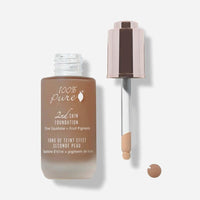
Read the ingredient list of the Fruit Pigmented 2nd Skin Foundation and you can watch it work: the colour is built from peach, apricot, cocoa, pomegranate, raspberry, wild cherry, coffee and micronised black tea, over a base of olive squalane. There are no FD&C dyes in it and no titanium dioxide filler.
The appeal is twofold. The pigments are plant-derived, which suits anyone keeping a routine short and readable. And the same fruits bring antioxidants along with the colour, so the formula does a little skincare while it wears.
What to expect: fruit pigments develop and settle over the first few minutes as they meet the warmth of your skin. Apply a thin layer, let it set, then judge the colour and add more only if you want it. The reward is a fresh, skin-like finish that looks like you, only more even, rather than a flat made-up mask.
Fruit pigments keep developing for a few minutes after you put them on. Apply a thin layer, walk away, and judge the colour once it has settled — not in the first thirty seconds.
How to choose a natural foundation for your skin type
The right foundation starts with your skin type, not the marketing.
+ Dry skin — look for hydrating, dewy or satin formulas with nourishing oils and humectants. Avoid heavily mattifying powders, which can cling to dry patches. A skin tint or a luminous foundation tends to flatter.
+ Oily or combination skin — lighter, breathable formulas with a natural-to-matte finish wear best. Build coverage in thin layers rather than one heavy one, and set only where you need to.
+ Sensitive or blemish-prone skin — mineral-led, fragrance-free formulas with short, recognisable ingredient lists are the safest bet. Patch-test first if your skin reacts easily.
+ Mature skin — favour hydrating, light-to-medium coverage with a soft, radiant finish. Very full, powdery coverage can settle into fine lines; a thinner, more skin-like layer looks fresher.
+ Normal or balanced skin — most finishes will suit you. Choose on the look you love, from a sheer skin tint to a fuller everyday foundation.
Whatever your type, the golden rule is the same: thin layers, built gradually, always over well-moisturised skin. If your base never seems to sit right whatever you buy, the problem is usually the skin underneath rather than the foundation on top.


How to shade-match a natural foundation: undertone and the jaw test
Shade-matching is where most foundation purchases go right or wrong, and it is worth a few careful minutes.
1 - Match to your jaw, not your hand or wrist. The skin on your jaw and neck is the colour you actually want to blend into.
2 - Test in daylight. Shop and bathroom lighting distort colour; natural light tells the truth. Swatch, step near a window, and look again.
3 - Apply a thin layer and wait. Natural and fruit-pigmented foundations settle over the first few minutes. Let it set before you judge — the right shade simply disappears, with no line at the jaw.
4 - Work out your undertone. Cool undertones suit a pink or rosy base; warm undertones suit golden or peachy bases; neutral sits in between. If the veins on your inner wrist look more blue you are probably cool, more green and probably warm. If you cannot tell, you are most likely neutral.
5 - When you are between two, take the lighter one for everyday and warm it with a touch of bronzer. Or choose a sheer skin tint, which flatters a wider range of tones and forgives a near-miss.
That gives you a shade. The next question is whether you can actually buy it.
Which shade, and can you actually get it?
Shade advice is only useful if the shade you land on is one you can buy. So here is the honest picture of what we carry, checked on 25 September 2026.
The Fruit Pigmented 2nd Skin Foundation runs across seven shades, named by undertone rather than by number alone, which makes matching at home far easier:
+ Shade 1 — fair, neutral undertone
+ Shade 2 — light, warm peach undertone
+ Shade 3 — light medium, warm undertone
+ Shade 4 — medium, warm undertone
+ Shade 5 — neutral with peachy undertones, for tan skin tones
+ Shades 6 and 7 — dark, neutral undertone
Not all seven are available at once. The range is currently strongest in the fair-to-tan band: Shade 1, Shade 4 and Shade 5 are ready to send. Shade 3 can still be added to a basket, though it is not showing stock with us, so it may take longer to reach you. Shade 2, Shade 6 and Shade 7 are not available from us at the moment — we would rather tell you here than let you find out at the basket.
The Fruit Pigmented Healthy Foundation is the fuller-coverage formula in the same family, and its shade range with us is narrow. Créme at the light end and Toffee at the deep end are the two you can buy, so treat it as a second choice unless one of those is your match.
The Ayuna Velo 6-in-1 is a single universal tint rather than a shade ladder, which removes the matching question entirely. It is not available at the moment, so read it as something to know about rather than plan around.
Stock moves, so the shade picker on each product page is always the last word. And if nothing lands on your tone, the honest advice is to wait rather than buy a shade that is nearly right. A foundation one step off never looks like skin.
Botā's edit: three natural foundations we rate
We would rather stand behind three formulas than pad out a top ten. Here is the edit, positioned honestly by what each one is for. You can see them together in the natural foundation collection.
1 - The everyday one: 100% PURE Fruit Pigmented 2nd Skin Foundation
This is the one we point most people to first, and it is the best-selling product in the whole shop. It is built to look like a second skin: colour from fruit pigments over a base of olive squalane, fragrance-free, and buildable from a light veil to a fuller, satin finish if you layer it. 100% PURE describe it as an ultralight serum foundation. Blend it with a slightly damp sponge and add a second layer only where you want more.
2 - The fuller-coverage one: 100% PURE Fruit Pigmented Healthy Foundation
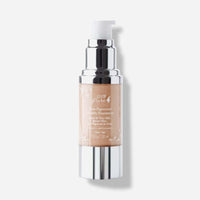
The same fruit-pigmented thinking, creamier and more covering, with acai, pomegranate, cocoa and goji berry in the formula and certified organic aloe juice as its base. Also fragrance-free. 100% PURE describe it as setting to a matte finish and note that it dries quickly, so blend it in sections rather than all at once. The catch is the shade range: only Créme and Toffee are available from us.
3 - The no-makeup one: Ayuna Velo 6-in-1
To be clear, this is not a foundation. Ayuna describe it as a six-in-one day cream with sun protection, and it carries the mineral filters zinc oxide and titanium dioxide with iron oxides for a soft universal tint. Two things worth knowing: unlike the two 100% PURE foundations it does contain fragrance, so skip it if you react to perfume in skincare, and it is not available at the moment.
Coverage, finish, and whether it sets itself
Two foundations with identical ingredient lists can look completely different on the skin, because coverage and finish are doing the talking.
Coverage runs along a spectrum:
+ Sheer, or skin tint — evens tone with a hint of colour and lets your skin show through. Best for good-skin days.
+ Light to medium — the everyday sweet spot. Smooths and evens while still looking like skin, and builds where you want more.
+ Full — covers redness and marks more completely. Apply in thin layers so it stays fresh rather than heavy.
Finish is about how it catches the light:
+ Dewy or luminous — radiant and fresh; flatters dry and mature skin.
+ Satin or natural — the most universally flattering; not flat, not shiny.
+ Matte — controls shine; best for oily skin, used sparingly so it does not look dry.
Does it set itself, or do you need powder over it?
This is the question that comes up most often in forum threads about clean foundation, and it is a fair one. A base that never sets transfers onto a collar all day.
The ingredient list tells you most of it. Look for a starch or a silica: rice starch, corn starch, silica and bamboo silica absorb a little surface oil and give a foundation its own soft set. The Fruit Pigmented 2nd Skin Foundation contains both rice starch and bamboo silica, and 100% PURE describe its finish as satin, so it tends to set on its own and often needs no powder at all. The Healthy Foundation goes further — the brand describes it as setting to a matte finish, which is why they suggest blending it in sections. Creamier formulas and skin tints stay softer, and those are the ones most likely to want a light dusting.
If you do reach for powder, the rule is the same as for foundation: less, and only where you need it. The centre of the face and around the nose is usually enough. Powdering the whole face is the quickest way to make a natural foundation look like makeup.
Frequently Asked Questions
There is no official definition of non toxic in cosmetics, so no foundation can be named the best non toxic one as a matter of fact. What you can compare is what is actually in them. Look for a full ingredient list published on the page, colour from mineral or plant pigments rather than synthetic dyes, and no added synthetic fragrance if your skin reacts easily. From Botā's edit, the one we recommend most is the 100% PURE Fruit Pigmented 2nd Skin Foundation: fragrance-free, coloured entirely by fruit and vegetable pigments, with no FD&C dyes in the formula.
No brand can be ranked as the most non toxic, because nobody certifies the term and nothing measures it. The more useful question is which brands publish enough for you to judge for yourself: a full ingredient list on every product page, a clear position on fragrance, and a straight answer when you ask. The two makeup brands Botā carries are 100% PURE, which colours its foundations with fruit and vegetable pigments instead of synthetic dyes, and Ayuna. The standard we apply before we stock anything is set out on our Clean Standards page.
Nobody can tell you which foundation is safest for your skin, and a brand that claims to is overreaching. Every cosmetic sold in the United Kingdom and the European Union has to pass a safety assessment before it can go on sale, so the starting point is the same for all of them. What differs is how a formula suits you. If your skin reacts easily, look for no added synthetic fragrance and a short ingredient list you can read, and patch-test on your inner arm before you put anything on your whole face. If your skin is persistently sore, itchy or broken out, speak to a pharmacist or a dermatologist rather than shopping for a different foundation.
There is no official list, and no authority certifies a brand as non toxic in the United Kingdom, so any list you find online is somebody's editorial pick rather than a register. Judge a brand on what it shows you: the full ingredient list on the page, a clear position on fragrance, and a retailer that will tell you what it does and does not stock, and why. Botā ships to the United Kingdom and prices in pounds. The makeup brands in our range are 100% PURE and Ayuna.
There is no single best one — it depends on your skin type, the coverage you want and, above all, your shade. From Botā's edit, the 100% PURE Fruit Pigmented 2nd Skin Foundation is the one we recommend most, for a skin-like, buildable finish that suits most skin types, and it is our best-selling product.
It depends on the formula, and the ingredient list usually tells you. A foundation with a starch or a silica in it — rice starch, corn starch, silica, bamboo silica — absorbs a little surface oil and sets softly on its own. The Fruit Pigmented 2nd Skin Foundation contains both rice starch and bamboo silica, and 100% PURE describe its finish as satin, so it often needs no powder at all. The Healthy Foundation is described by the brand as setting to a matte finish. Creamier formulas and skin tints stay softer and are the ones most likely to want a light dusting, centre of the face only.
Swatch on your jaw, not your hand, and check in daylight rather than artificial light. Apply a thin layer and let it settle for a few minutes, as fruit-pigmented foundations develop slightly. The right shade disappears into your skin with no line at the jaw. If you are between two, take the lighter one for everyday and warm it with a touch of bronzer.
Choosing your natural foundation: the short version
Non toxic, clean, natural and organic are shopping words, not safety verdicts. Use them to narrow the field, then judge the formula on your own face. The best natural foundation is the one that suits your skin, your shade and the look you love, not the one with the longest checklist.
Start with your skin type. Choose your coverage and finish. Shade-match on your jaw in daylight, and build in thin layers. And if your base never seems to sit right whatever you buy, it helps to start with a healthy canvas — our guide to what the skin barrier is and why it matters is a good place to begin.
A simple starting point: the 100% PURE Fruit Pigmented 2nd Skin Foundation is the everyday one we recommend most, the Healthy Foundation gives more coverage if Créme or Toffee is your shade, and the Ayuna Velo tint is the barely-there option for when it comes back. Browse them together in the natural foundation collection, and check your tone on the product page before you commit.